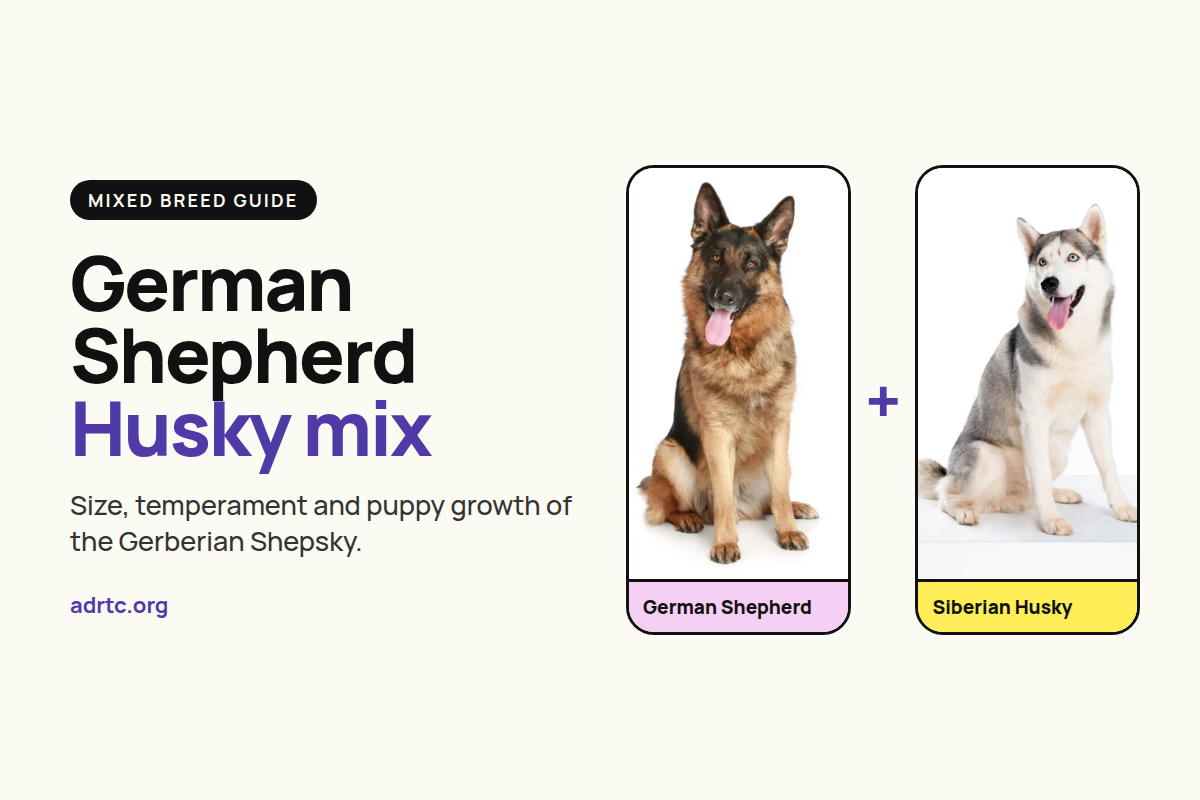
A German Shepherd Husky mix, also called a Gerberian Shepsky or Shepsky, is a cross between a German Shepherd and a Siberian Husky. Most grow into large, very active dogs of 35 to 88 pounds that shed heavily, need hard exercise every day, and are smart enough to learn fast and stubborn enough to ignore you when they choose.
The mix is not a recognized breed, so there is no standard for size or looks. What you get depends on which parent each puppy takes after. The ranges below come from our German Shepherd and Siberian Husky breed profiles, and the puppy growth figures from the AKC.
Key takeaways
- Expected adult size: 45 to 88 lb for males and 35 to 71 lb for females, based on the two parent breeds.
- Both parents are rated 5/5 for energy and exercise needs. A Shepsky is a poor match for a quiet home.
- Training is the biggest coin toss: German Shepherds rate 5/5 for ease of training, Huskies 2/5.
- Most large puppies reach full size between 18 and 24 months (AKC).
In this guide
German Shepherd Husky mix: quick facts
| Gerberian Shepsky | |
|---|---|
| Other names | Shepsky, German Shepherd Husky mix, GSD Husky mix, Siberian Husky Shepherd mix |
| Parents | German Shepherd and Siberian Husky |
| Recognized breed? | No. It is a mixed breed with no kennel club standard |
| Height | 21 to 26 in (males), 20 to 24 in (females) |
| Weight | 45 to 88 lb (males), 35 to 71 lb (females) |
| Lifespan | About 10 to 14 years |
| Common colors | Black and tan, black and white, gray and white, sable, red, white |
| Shedding | Heavy, with seasonal coat blows |
| Energy | Very high |
What is a Gerberian Shepsky?
A Gerberian Shepsky is a dog with one German Shepherd parent and one Siberian Husky parent. The name joins the two breed names: Gerberian from German and Siberian, Shepsky from Shepherd and Husky. A first-generation cross has one parent of each breed. Puppies from two Shepsky parents are even harder to predict.
Because the Gerberian Shepsky dog is a mix, no kennel club writes a standard for it. Two puppies from the same litter can look and act very differently. One may have the Shepherd’s black saddle and upright ears, while a sibling has the Husky’s mask and pale blue eyes. Meeting both parents is the best preview you will get.
“Husky” usually means the Siberian Husky, but some Shepskies come from the Alaskan Husky, a working sled dog type that varies more in size.
German Shepherd vs Siberian Husky: what each parent brings


The German Shepherd and the Siberian Husky agree on energy and family life and disagree on almost everything else. Our ratings, from 1 to 5, show where a Shepsky could land.
The biggest gap is training. The Shepherd rates 5/5 and the Husky 2/5, so a Shepsky can be a joy or a puzzle to teach. The ratings flip for other dogs (Husky 5/5, Shepherd 2/5), which makes early socialization important. The Husky’s dense double coat also rates harder to groom.
German Shepherd Husky mix size: how big does a Shepsky get?
A full grown Shepsky usually lands between its parents. Since the Siberian Husky is a medium breed and the German Shepherd a large one, the possible range is wide.
| Siberian Husky | German Shepherd | Gerberian Shepsky (expected) | |
|---|---|---|---|
| Height, male | 21 to 24 in | 24 to 26 in | 21 to 26 in |
| Height, female | 20 to 22 in | 22 to 24 in | 20 to 24 in |
| Weight, male | 45 to 60 lb | 66 to 88 lb | 45 to 88 lb |
| Weight, female | 35 to 50 lb | 49 to 71 lb | 35 to 71 lb |
To narrow the Gerberian Shepsky size down, ask for the weight of both parents. A puppy from a 55 lb Husky mother and an 85 lb Shepherd father will most likely end up somewhere between the two.
Shepsky growth: what to expect at 4 months, 6 months and full grown
The AKC publishes a puppy growth chart by adult size. A Shepsky that will weigh over 50 lb follows the large-dog column, and a smaller one follows the medium column. Large dogs are about 60% grown at 6 months and fully grown around 18 months, according to the AKC’s growth guide.
| Age | Large dog (51 to 100 lb) | 70 lb adult | Medium dog (21 to 50 lb) | 48 lb adult |
|---|---|---|---|---|
| 6 months | 60% | about 42 lb | 66% | about 32 lb |
| 9 months | 75% | about 53 lb | 85% | about 41 lb |
| 12 months | 85% | about 60 lb | 95% | about 46 lb |
| 15 months | 95% | about 67 lb | 100% | about 48 lb |
| 18 months | 100% | 70 lb | 100% | 48 lb |
A 4 month old Gerberian Shepsky
At four months a Shepsky is all paws and ears, and the AKC chart does not list a figure that young. Expect a gangly puppy that grows fast from week to week. Weigh her again at six months and use the estimator below for a better guess.
A Gerberian Shepsky at 6 months
By six months she is roughly 60% to 66% grown, depending on whether she is heading for the large or medium range. Puppies reach their adult height before they fill out with muscle, so a lanky, leggy look at this age is normal.
When is a Shepsky full grown?
The AKC says large breeds may keep developing until 18 to 24 months. Its German Shepherd training timeline adds that a Shepherd may not reach adult maturity until age two or three (AKC). Plan for a Shepsky that looks grown at a year and a half but still acts like a teenager for a while after.
Shepsky adult weight estimator
Enter your puppy’s age and current weight. The estimate applies the AKC growth percentages above to weight.
A rough guide. Mixed breeds vary, and the AKC labels its chart approximate.
Gerberian Shepsky temperament
Most Shepskies are loyal, playful and full of energy. The German Shepherd and the Siberian Husky both rate 5/5 with kids on our breed pages, and both rate 5/5 for playfulness. The differences show up in how they listen and how they treat strangers and other dogs.
| If she takes after the German Shepherd | If she takes after the Siberian Husky |
|---|---|
| Eager to work with you and quick to learn cues | Independent; learns fast but decides when to obey |
| Watchful and protective with strangers | Friendly with almost everyone, including burglars |
| Can be choosy about other dogs | Usually social with other dogs |
| Barks to alert you | Howls and “talks” more than barks |
Start training and socializing early, with short daily sessions and lots of rewards. Our guides on training arctic breeds and socializing Siberian Huskies apply to the Husky side of the mix.
Tip: treat the recall cue (“come”) as unreliable until proven. Many Husky-type dogs run off after a scent or a squirrel, so use a long line in open areas.
Shepsky colors and eyes
The German Shepherd side brings black, black and tan, black and silver, and black and red. The Siberian Husky side brings black and white, gray and white, red and white, sable and white, agouti and pure white. A Shepsky can show any mix of these. Blue eyes, brown eyes or one of each are all possible, since the Husky standard allows all three.
White husky German Shepherd mix (white Gerberian Shepsky)
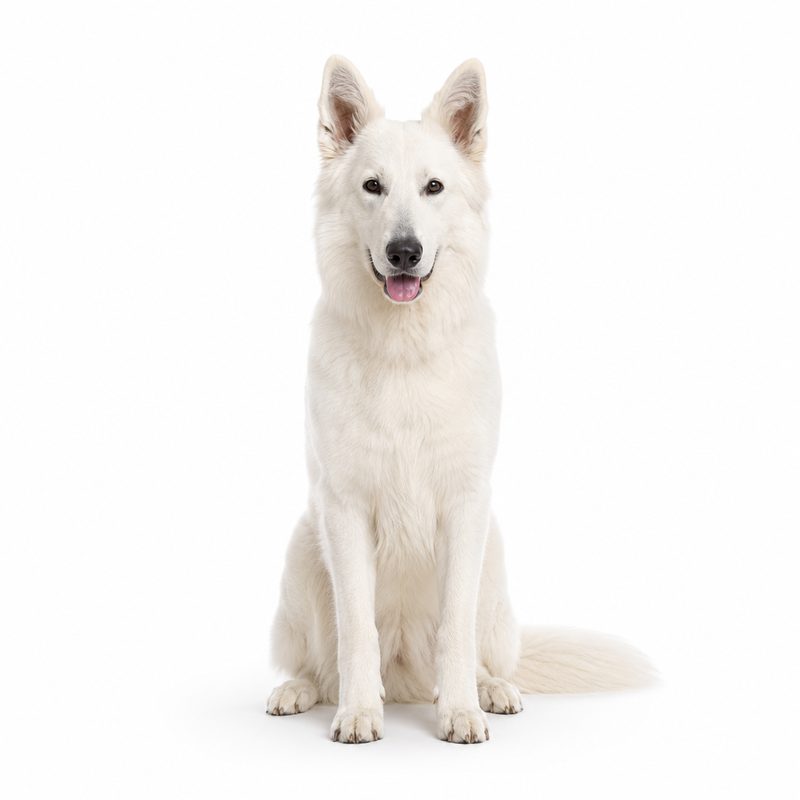
A white husky German Shepherd mix needs white genes from both sides. That usually means a pure white Siberian Husky paired with a white Shepherd. White coats disqualify a German Shepherd in the AKC breed standard, which is why white Shepherds are bred separately as the American White Shepherd.
Black and white German Shepherd Husky mix
Black and white is the classic Husky pattern, often with a white face mask. A black and white German Shepherd Husky mix usually gets it from the Husky parent, sometimes with a Shepherd-style saddle on the back.
Shedding and grooming
Expect dog hair everywhere. The German Shepherd rates 5/5 for shedding and the Siberian Husky 4/5, and both have a double coat that “blows” heavily once or twice a year. Neither parent is hypoallergenic.
- Brush two or three times a week, and daily during shedding season.
- An undercoat rake removes loose fur faster than a regular brush.
- Bathe only when she is dirty. Frequent baths dry out the coat.
- Never shave a double coat. It protects against both cold and sun.
If shedding is a deal breaker, look at our low-shedding dog breeds instead.
Exercise and living space
Both parents rate 5/5 for energy level and exercise needs, the top of our scale. A bored Shepsky digs, chews, howls and looks for a way out of the yard. Plan for real exercise every day: running, hiking, fetch, or dog sports such as canicross and bikejoring, which suit the Husky’s pulling instinct.
| Home | Fit for a Shepsky? |
|---|---|
| House with a securely fenced yard | Best fit, as long as the fence is tall and dig-proof |
| Apartment | Possible only with an active owner and a lot of daily exercise |
| Hot climate | Manageable with early and late walks; the thick coat is built for cold |
| Home alone all day | Poor fit. Shepskies get bored and destructive |
German Shepherd Husky mix lifespan
A Gerberian Shepsky lifespan is usually about 10 to 14 years. That sits between its parents: our breed pages list 10 to 13 years for the German Shepherd and 12 to 14 years for the Siberian Husky. Ask the breeder or rescue for health records on both parents, and keep up regular vet checkups.
Getting a German Shepherd Husky mix puppy
A German Shepherd Husky mix puppy can come from a breeder, a rescue or a shelter. No breed club sets rules for the mix, so look carefully at where any Gerberian Shepsky puppy comes from.
- Meet at least the mother, and ideally both parents, to see their size and temperament.
- Ask how the puppies are socialized with people, noise and other dogs.
- Walk away from sellers who ship puppies sight unseen or always have litters available.
- Check husky and shepherd rescues. Shepsky mixes do turn up there, sometimes as adults whose size and personality you can already see.
New to adoption? Read how to adopt a rescue dog and our guide to arctic dog adoption fees.
Is a Gerberian Shepsky right for you?
A Shepsky suits active people who like training and don’t mind fur. It is a poor match for a first-time owner who wants a calm dog. Answer four questions to check your fit.
If the answer is no, look at our low-energy dog breeds, or browse large dog breeds by temperament.
FAQ about the German Shepherd Husky mix
Are German Shepherd Husky mixes good family dogs?
They can be. Both parents rate 5/5 with kids on our breed pages. A Shepsky needs an active family that has time for daily exercise and training, and young children should be supervised around any large, bouncy dog.
How big is a full grown Shepsky?
Usually 21 to 26 inches tall and 45 to 88 lb for males, or 20 to 24 inches and 35 to 71 lb for females. The parents' weights are the best guide to where your dog will land.
Do Gerberian Shepskies shed a lot?
Yes. Both parents are heavy shedders with double coats, and neither is hypoallergenic.
Can a Shepsky have blue eyes?
Yes. Blue eyes come from the Siberian Husky side. Some Shepskies have one blue and one brown eye.
How long do German Shepherd Husky mixes live?
About 10 to 14 years, between the German Shepherd's 10 to 13 and the Siberian Husky's 12 to 14 years.
Is a Gerberian Shepsky good for a first-time owner?
Usually not. The mix combines very high energy, heavy shedding and an independent streak. An experienced owner, or a first-timer committed to a training class, will do much better.
Compare the parents in detail on our German Shepherd and Siberian Husky pages, or browse all 373 dog breeds.
Leave a Reply