Dachshund
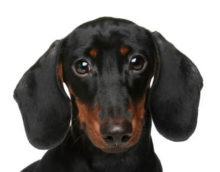
Dachshund breed is originally from Germany. Also known as Teckel, Tekkel, Tekkel Doxie, Weenie Dog, Sausage Dog, Bassotto, Worshond.
Breed information
| Popularity |
|
| Name | Dachshund |
| Other names | Teckel, Tekkel, Tekkel Doxie, Weenie Dog, Sausage Dog, Bassotto, Worshond |
| From country | Germany |
| Standards | |
| Breed groups | Hound (AKC),Scenthound Breeds (UKC) |
| Type | Purebred |
| Size | Tiny, Small, Medium |
| Life span | 12 - 16 years |
| Temperament | clever,courageous,devoted,lively,playful,stubborn |
| Height female | Standard: 8-9 inches (20-23 cm); Miniature: 5-6 inches (13-15 cm) |
| Height male | Standard: 8-9 inches (20-23 cm); Miniature: 5-6 inches (13-15 cm) |
| Weight female | Standard: 16-32 pounds (7-15 kg); Miniature: up to 11 pounds (5 kg) |
| Weight male | Standard: 16-32 pounds (7-15 kg); Miniature: up to 11 pounds (5 kg) |
| Colors | black,black and tan,blue,brown,red |
| Litter Size | 4 - 8 puppies |
| Puppy Price | Average $800 - $1500 USD |
Dachshund breed image
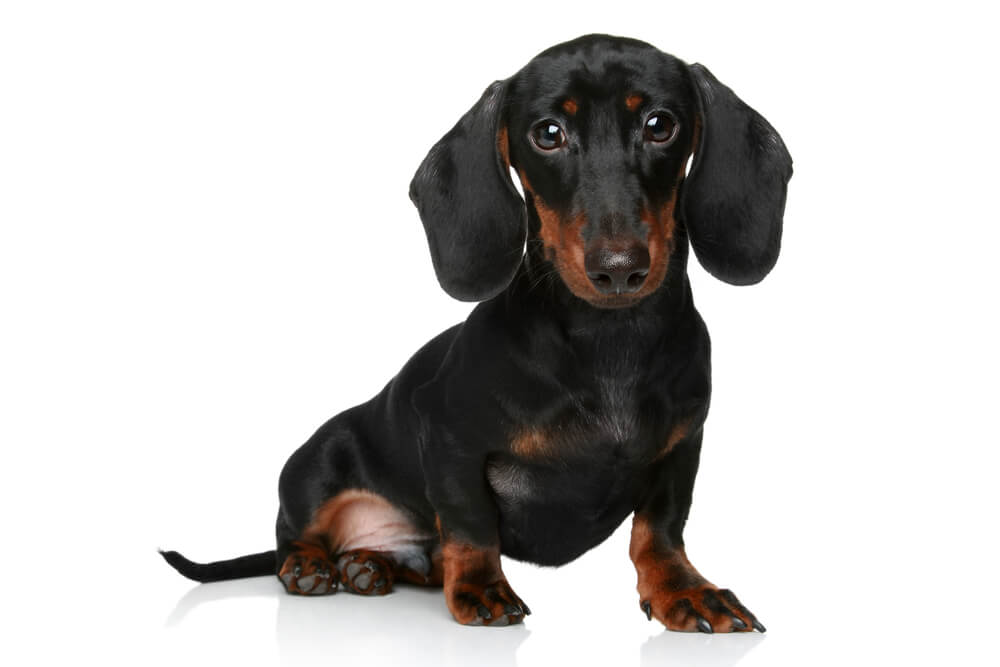
Dachshund Pros and Cons
There are 2 pros and 3 cons of owning Dachshund.
| Pros 👍 | Cons 👎 |
|---|---|
| Kid-friendly | Needs more attention to his health |
| High intelligence | Makes a lot of noise |
| Not hypoallergenic |
Breed Characteristics
| Sensitivity Level |
Low-sensitive
High-sensitive
|
High-sensitivity dogs can be deeply affected by their owner's actions. If you shout loudly at the dog, ignore it, or if your child pulls its tail, it may take offense. On the other hand, low-sensitivity dogs, often referred to as 'tolerant' dogs, handle these situations more easily. If you're an emotional person, have a busy lifestyle, sometimes neglect your dog, or have young children, we don't recommend getting a high-sensitivity dog. |
|
| Kid-Friendly |
No-Kid-Friendly
Kid-Friendly
|
Kid-friendly dogs are highly tolerant of children's behavior, including hugs and playful "games" like attempting to saddle them. They typically interact kindly and patiently with kids, making them great family pets. Not Kid-Friendly Dogs - Dogs in this category do not tolerate such behavior from children and may react negatively or even aggressively. Be cautious about bringing a not kid-friendly dog into a family environment. |
|
| Dog Friendly |
Low-friendly
High-Friendly
|
Dog-friendly characteristics vary widely, ranging from low-friendly to high-friendly. It's important to note that a dog's level of friendliness depends on several factors, and breed is just one of them. Dogs with high friendliness tend to be sociable and enjoy interacting with other dogs. They may happily play with other canines or simply remain calm and relaxed when in the company of other dogs. Conversely, dogs with lower levels of friendliness may exhibit different behaviors. They might be more prone to barking, trying to engage in fights with other dogs, or even attempting to run away from unfamiliar dogs or situations. Keep in mind that a dog's friendliness is influenced by their individual personality, upbringing, and experiences. So, it's essential to consider these factors when assessing your furry friend's social behavior. |
|
| Friendly Toward Strangers |
Not-friendly
Everyone Is My Best Friend
|
It's important to understand that a dog's behavior towards strangers is influenced by various factors, with breed being just one of them. A dog that is friendly toward strangers will typically exhibit pleasant behavior when your friends or visitors come to your home. They won't display aggression or attempt to attack them. Instead, they will likely be welcoming and sociable. On the other hand, some dogs may be naturally shy or even fearful of strangers. However, it's crucial to note that a dog's socialization plays a significant role in their behavior. Proper socialization lessons can help any dog become more welcoming to strangers, regardless of their breed. That said, if you happen to choose a breed known for its high stranger-friendly rating but don't invest time in training and socialization, the dog may still exhibit unfriendly behavior toward your visitors. Remember, a dog's behavior is a product of both their breed tendencies and their upbringing. |
|
| Amount Of Shedding |
No Shedding
Hair Everywhere
|
|
What's crucial to note is that the extent of shedding can vary from one breed to another. Some dogs shed consistently throughout the year, while others may have specific seasonal shedding patterns. There are also breeds that shed minimally, and in some cases, almost not at all. When choosing a dog, it's essential to consider your personal preferences and standards regarding shedding. Your choice should align with how much you're willing to handle in terms of grooming and cleaning to keep your home and clothes free from excessive dog hair. |
|
| Easy To Groom |
Hard
Easy
|
|
Some breeds are low-maintenance and can be brushed quickly and easily. Others may need regular clipping, grooming, and bathing to keep them looking their best. When choosing a dog, it's important to assess how much time and money you're willing to invest in their grooming needs. Your decision should align with your preferences and your commitment to providing the necessary care for your furry friend. |
|
| General Health |
Need more attention to health
Healthy as an ox
|
|
It's important to be aware that some dogs may face health challenges due to irresponsible breeding practices. One example of such health issues is hip dysplasia, which is a genetic problem. However, it's essential to understand that not every dog of a specific breed will develop these health issues, although they may be more prone to them. When adopting a puppy, it's a good practice to gather information about any genetic illnesses associated with the breed. For more detailed information, you may also want to consult with a shelter or rescue organization, as they can provide insights into the physical health of the puppy's parents or siblings. |
|
| Easy To Train |
Self-Willed
Eager to Please
|
|
It's worth noting that some dog breeds are more trainable than others. For instance, certain breeds may quickly grasp and establish associations between words like 'stay,' corresponding actions (such as staying in place), and the resulting rewards. On the other hand, some breeds may require more time and attention during training. Dogs are highly intelligent animals, but they often like to understand what's in it for them when they follow your commands. This is where games and rewards can be valuable tools in training and motivating them. |
|
| Intelligence |
Low
High
|
|
Different dog breeds excel in specific tasks and exhibit varying levels of intelligence, concentration, and quick decision-making abilities. For instance, breeds bred for their intelligence, like Border Collies, may excel in activities such as herding livestock. These dogs require more mental stimulation to thrive compared to breeds designed for physical endurance and running. Understanding your dog's specific needs is essential to ensure they are mentally engaged and don't engage in unwanted behaviors like chewing and digging. To meet these needs, consider interactive toys and activities, such as obedience training for dogs in need of mental engagement, or search and rescue activities for those with high activity levels and keen senses. |
|
| Tendency To Bark Or Howl |
Only To Alert
Avid singer
|
|
It's important to understand that vocalization varies between dog breeds. Some dogs are naturally more vocal, and they can bark and howl at different pitches. For instance, consider the hound, known for its distinctive barking and howling. You'll need to decide if the sound of their vocalizations might become bothersome or if you find it somewhat musical. Additionally, if your chosen breed has a history of hunting, they might constantly chase and howl at nearby wildlife. If you're looking for a watchdog and your dog is alert, it may bark at everyone it encounters. These factors are essential to consider when selecting a dog breed, especially if you have neighbors or are subject to any noise restrictions. |
|
| Energy Level |
Couch Potato
High Energy
|
|
A dog's energy level is often influenced by their breeding, as some breeds were designed for specific tasks like herding livestock or retrieving game for hunters. Dogs with high energy levels will require plenty of interaction and exercise. They tend to be more active and enjoy activities such as playing, running, tumbling, and exploring new smells and sights. On the other hand, some breeds are low-energy and prefer lounging on the couch with you, taking naps, and enjoying Netflix marathons. When choosing a dog breed, it's essential to consider your own activity level and lifestyle. Select a breed that aligns with your preferences and can comfortably fit into your daily routine. |
|
| Exercise Needs |
Low
Need a lot
|
|
Different dog breeds have varying requirements when it comes to physical activity. Some breeds may be content with a leisurely stroll in the evening, while others might crave several vigorous laps around the block. Their exercise needs are often linked to their original purposes, such as hunting or herding, which influence their energy levels. Dogs with high energy levels that don't receive adequate exercise may be prone to weight gain and may engage in behaviors like digging, chewing, and excessive barking. High-energy dogs tend to thrive when paired with individuals who are active, enjoy the outdoors, or have an interest in training their dog for competitions. |
|
| Potential For Playfulness |
Only When You Want To Play
Non-Stop
|
|
Dog breeds exhibit a wide range of personalities, and this includes their inclination for play. Some breeds are consistently playful and seem to stay in a perpetual puppy state of mind. In contrast, other breeds tend to be more serious and enjoy their moments of relaxation. When choosing a dog, it's important to consider whether the idea of having a playful companion excites you or if you prefer a more relaxed and laid-back dog. Additionally, factors such as the presence of children or other pets in your household should be taken into account. Another option to explore is adopting an older dog, which might be less demanding but still enjoys interacting and playing, providing a balance between playfulness and a calmer demeanor. |
|
What were Dachshunds bred for?
In German, Dachs means badger and Hund means dog, and that is what Dachshunds were bred for: following a badger into its sett and holding it there until the hunter could dig down to it. A badger weighs as much as a large Dachshund and fights hard in a confined space, so the job called for a dog that was small enough to fit the tunnel and stubborn enough not to back out.
Almost everything people notice about the breed today comes from that work:
- Short legs and a long body: low enough to crawl along an earth tunnel, with room for the heart and lungs of a much bigger dog.
- A deep, keel-shaped chest, which gives stamina underground and plenty of air for barking.
- Big, paddle-like front feet made for digging. Many Dachshunds still excavate flower beds with real commitment.
- A loud, deep bark. Once the dog was out of sight below ground, its voice told the hunter where to dig, which is why a 10-pound Dachshund can sound like a dog three times its size at your front door.
- An independent mind. Nobody could give a dog commands down in the dark, so it had to decide for itself, and Dachshunds still like to.
Badger was not the only quarry. German hunters also used Dachshunds on fox and rabbit, and in packs to track wounded deer and wild boar. In Germany the breed (usually called Teckel or Dackel there) still works as a blood-tracking dog, finding wounded game by scent hours after a shot.
Dachshund history and origin
You will often read that Dachshunds appear on ancient Egyptian tomb paintings. Short-legged dogs do show up in Egyptian art, but there is no line connecting them to the modern breed. The Dachshund as we know it is German. Short-legged badger dogs are described in German hunting books from the late 1600s and early 1700s, and the type was refined over the next two centuries by foresters and hunters who cared about working ability more than looks.
A few dates worth knowing:
- 1840s onward: Queen Victoria kept Dachshunds, and the breed became fashionable in Britain.
- 1885: the American Kennel Club registered the Dachshund, one of its earliest breeds.
- 1888: the Deutscher Teckelklub, the German breed club, was founded. It is still one of the oldest breed clubs in the world.
- 1914-1918 and again in the 1940s: the breed's German image hurt it badly in the US and UK, and registrations dropped. Dachshunds were sometimes called "liberty hounds" to get around the association.
- 1972: a striped Dachshund named Waldi became the first official Olympic mascot, at the Munich Games.
The breed recovered from both wars and today sits near the top of the AKC popularity list, which the breed information above shows year by year.
Coats, sizes and colors
Three coat types
- Smooth: the original and still the most familiar. Short, shiny and very easy to keep.
- Longhaired: soft, slightly wavy coat with feathering on the ears, chest and tail. Often a little calmer than the other two, and it needs regular combing to prevent mats behind the ears.
- Wire-haired: developed in the late 1800s, probably by crossing in rough-coated terriers, to give hunters a dog that could push through brambles. Wire-haired Dachshunds tend to have more terrier in their attitude too. The coat needs hand-stripping a couple of times a year to stay correct.
Standard vs miniature Dachshund
The AKC recognizes two sizes. A standard Dachshund weighs 16 to 32 pounds and stands about 8 to 9 inches at the shoulder. A miniature is 11 pounds or less and about 5 to 6 inches tall. Dogs that land between the two are sometimes called "tweenies"; that is a nickname, not a show class. There is no official "toy" Dachshund.
The FCI, which sets the standard used in Germany and most of Europe, measures chest circumference instead of weight and recognizes a third, smaller size: the Kaninchen, or rabbit Dachshund, bred narrow enough to follow rabbits underground. Under the FCI standard a standard Dachshund has a chest over 35 cm, a miniature 30 to 35 cm, and a Kaninchen under 30 cm.
Dachshund colors and the dapple pattern
Red, black and tan, and chocolate and tan are the classics, and the AKC standard lists many more, from cream and wheaten to wild boar (a grizzled mix of dark and light hairs common in wires). On top of the base color come patterns: brindle, sable, piebald and dapple.
Dapple is the Dachshund name for the merle gene, which gives a mottled coat and sometimes blue or partly blue eyes. One copy is harmless. Two copies, from breeding dapple to dapple, produce "double dapples," which have a high risk of deafness, small or missing eyes and blindness. A responsible breeder never mates two dapples, so ask about both parents if you are looking at a dapple puppy.
Dachshund temperament and personality
Owners describe the Dachshund temperament as a big dog in a small body, and it is accurate. These are bold, curious, funny dogs that attach strongly to their people. They were also bred to think for themselves, which shows up in daily life:
- Training. Dachshunds are clever but not eager to please. They learn fast when there is food or a game in it and lose interest in repetition. Keep sessions short and make the reward worth their while. House-training is the classic sticking point, especially in bad weather, so expect it to take longer than with many breeds.
- Barking. They do bark a lot. It was a job requirement. You can teach a "quiet" cue, but you will not breed it out of the dog.
- Prey drive and digging. Squirrels, cats and anything in a hole will get their full attention. Recall off-lead is unreliable in most Dachshunds, and a fence needs to go below ground as well as above it.
- Strangers. Many are reserved or suspicious with people they don't know and make keen, noisy watchdogs. Early socialization helps a lot.
- Children. A well-socialized Dachshund can be a good family dog, but its back is fragile and it will not tolerate being picked up badly or squeezed. They do best with kids old enough to sit on the floor and play gently.
Dachshund back problems: IVDD
The breed's biggest health issue is intervertebral disc disease (IVDD). According to the UK Dachshund Breed Council, around 1 in 4 Dachshunds may be affected at some point in their lives. The discs between the vertebrae harden early in the breed, sometimes before the dog is two, and a hardened disc can rupture and press on the spinal cord.
A long back is part of the story, but the root cause is genetic. In 2017 researchers at UC Davis traced both the short legs and the early disc degeneration in several breeds, Dachshunds included, to an extra copy of a gene called FGF4 on chromosome 12. In other words, the mutation behind the short legs is also behind the bad discs.
You cannot remove the risk, but you can lower it:
- Keep your dog lean. Extra weight puts more load on the spine, and Dachshunds put on weight easily.
- Give it regular exercise. Fit muscles support the back better than weak ones.
- Use ramps or steps for the sofa and bed, and discourage jumping down from height.
- Walk on a harness rather than a collar if your dog pulls.
- Pick it up with one hand under the chest and the other under the rear, keeping the back level.
Know the warning signs: reluctance to move or jump, a hunched back, yelping when touched, wobbling or dragging the back legs. If your Dachshund suddenly cannot walk normally, treat it as an emergency and see a vet the same day. Outcomes are much better when treatment starts early. In the UK, breeders can have their dogs X-rayed through an IVDD screening program that grades disc calcification, so ask a breeder whether the parents were screened.
Fun facts about Dachshunds
- The nickname "wiener dog" compares the dog's shape to a Vienna sausage (Wiener means "from Vienna"). The British say "sausage dog" for the same reason.
- Britain's first cloned dog was a Dachshund. In 2014 a London owner won a competition run by the South Korean firm Sooam Biotech, and her 12-year-old Dachshund Winnie was cloned. The puppy, Mini Winnie, was born in Seoul and later brought home to the UK.
- Dachshunds also have a place in sport. AKC earthdog tests send them through tunnels to reach caged (and safe) rats, which is about as close to the old job as a modern dog gets.
Exercise and daily care
A Dachshund is not a lapdog, even a miniature one. Plan on a couple of good walks a day with time to sniff, plus some play or scent games at home: hide treats in a snuffle mat or a rolled towel and let the dog hunt for them. Bored Dachshunds dig and bark, and they also put on weight, which is the bigger problem for their backs.
Grooming depends on the coat. Smooths need little more than a wipe-down, longhairs need combing a few times a week, and wires need brushing plus stripping twice a year. Check the long ears weekly and keep nails short, since long nails change the way a low dog stands and walks.
Sources
- American Kennel Club: Dachshund breed information
- Dachshund Club of America
- FCI breed standard No. 148: Dachshund (PDF)
- Dachshund Breed Council (UK): IVDD
- Brown et al. (2017), "FGF4 retrogene on CFA12 is responsible for chondrodystrophy and intervertebral disc disease in dogs", PNAS
- The Kennel Club (UK): Miniature Smooth Haired Dachshund
Video about Dachshund breed
Questions and answers about Dachshund
Yes, Dachshund's typical characteristics indicate that this breed of dog is an ideal companion for kids and makes it a family pet. But anyway You mustn't leave the kid and dog alone!
The average life expectancy of a Dachshund is between 12 - 16 years.
If your Dachshund is pregnant, it is safe to assume that litter can have anywhere from 4 to 8 puppies.
If you purchase Dachshund from a breeder it can be much more expensive than a shelter. A purebred Dachshund costs between US$ 800 and US$ 1500 from a reputable breeder, but there are several advantages to doing so. First, a breeder will usually allow you to meet the parents to get a good idea about what the puppy will look like and behave. You will also see if the parents have any health problems. Breeders will also supply you with paperwork that documents your pet’s lineage.
Yes, they do a lot
Yes, Dachshund has gained immense popularity in America. It's in top 5 the most popular purebred dog in USA by American Kennel Club (AKC). Dachshund have got #5 rank in 2025, #6 in 2024, #6 in 2023, #9 in 2022 and #10 in 2021 by American Kennel Club (AKC).
No, Dachshund are not considered hypoallergenic dogs. If you are thinking about getting a Dachshund and have allergies, it's important to spend time with the breed to see how you react before bringing one into your home. This can help you make an informed decision about whether a Dachshund is the right pet for you, and if so, what steps you may need to take to manage any allergy symptoms.
- https://www.akc.org
- FCI standard
- Kennel club standard
- Wikipedia https://en.wikipedia.org/wiki/Dachshund
Next and previous breeds by Popularity

German Shepherd
Popularity: №4

Poodle
Popularity: №6