French Bulldog

French Bulldog breed is originally from France,United Kingdom. Also known as Frenchie, Bouledogue Français.
French Bulldogs are small, friendly dogs. They have a cheerful, good-natured, playful personality and unusual appearance.
Breed information
| Popularity | 1 of 202 (2025) · rose from 11th in 2013 |
| Name | French Bulldog |
| Other names | Frenchie, Bouledogue Français |
| From country | France,United Kingdom |
| Standards | |
| Breed groups | Non Sporting (AKC),Companion (UKC) |
| Type | Purebred |
| Size | Small |
| Coat | Short · smooth |
| Life span | 10 - 12 years |
| Temperament | affectionate,playful,alert,athletic,bright,easygoing,keen,lively,patient |
| Height female | 11-13 inches (28-33 cm) |
| Height male | 11-13 inches (28-33 cm) |
| Weight female | 16–25 pounds (7–11 kg) |
| Weight male | 16–25 pounds (7–11 kg) |
| Colors | brindle,brindle & white,cream,fawn,fawn & white,fawn brindle,white,white & brindle,white & fawn |
| Litter Size | 3 - 5 puppies |
| Puppy Price | Average $2000 - $4000 USD |
French Bulldog popularity by year (AKC)
| Year | 2013 | 2014 | 2015 | 2016 | 2017 | 2018 | 2019 | 2020 | 2021 | 2022 | 2023 | 2024 | 2025 |
|---|---|---|---|---|---|---|---|---|---|---|---|---|---|
| Rank | 11 | 9 | 6 | 6 | 4 | 4 | 4 | 2 | 2 | 1 | 1 | 1 | 1 |
Source: American Kennel Club registration statistics. All breeds ranked by popularity
French Bulldog breed image

French Bulldog Pros and Cons
There are 4 pros and 2 cons of owning French Bulldog.
| Pros 👍 | Cons 👎 |
|---|---|
| Good with children | Prone to health problems |
| Good with other dogs | Not hypoallergenic |
| Easy to groom | |
| Doesn't need much exercise |
Breed Characteristics
| Sensitivity Level |
Low-sensitive
High-sensitive
|
High-sensitivity dogs can be deeply affected by their owner's actions. If you shout loudly at the dog, ignore it, or if your child pulls its tail, it may take offense. On the other hand, low-sensitivity dogs, often referred to as 'tolerant' dogs, handle these situations more easily. If you're an emotional person, have a busy lifestyle, sometimes neglect your dog, or have young children, we don't recommend getting a high-sensitivity dog. |
|
| Kid-Friendly |
No-Kid-Friendly
Kid-Friendly
|
Kid-friendly dogs are highly tolerant of children's behavior, including hugs and playful "games" like attempting to saddle them. They typically interact kindly and patiently with kids, making them great family pets. Not Kid-Friendly Dogs - Dogs in this category do not tolerate such behavior from children and may react negatively or even aggressively. Be cautious about bringing a not kid-friendly dog into a family environment. |
|
| Dog Friendly |
Low-friendly
High-Friendly
|
Dog-friendly characteristics vary widely, ranging from low-friendly to high-friendly. It's important to note that a dog's level of friendliness depends on several factors, and breed is just one of them. Dogs with high friendliness tend to be sociable and enjoy interacting with other dogs. They may happily play with other canines or simply remain calm and relaxed when in the company of other dogs. Conversely, dogs with lower levels of friendliness may exhibit different behaviors. They might be more prone to barking, trying to engage in fights with other dogs, or even attempting to run away from unfamiliar dogs or situations. Keep in mind that a dog's friendliness is influenced by their individual personality, upbringing, and experiences. So, it's essential to consider these factors when assessing your furry friend's social behavior. |
|
| Friendly Toward Strangers |
Not-friendly
Everyone Is My Best Friend
|
It's important to understand that a dog's behavior towards strangers is influenced by various factors, with breed being just one of them. A dog that is friendly toward strangers will typically exhibit pleasant behavior when your friends or visitors come to your home. They won't display aggression or attempt to attack them. Instead, they will likely be welcoming and sociable. On the other hand, some dogs may be naturally shy or even fearful of strangers. However, it's crucial to note that a dog's socialization plays a significant role in their behavior. Proper socialization lessons can help any dog become more welcoming to strangers, regardless of their breed. That said, if you happen to choose a breed known for its high stranger-friendly rating but don't invest time in training and socialization, the dog may still exhibit unfriendly behavior toward your visitors. Remember, a dog's behavior is a product of both their breed tendencies and their upbringing. |
|
| Amount Of Shedding |
No Shedding
Hair Everywhere
|
|
What's crucial to note is that the extent of shedding can vary from one breed to another. Some dogs shed consistently throughout the year, while others may have specific seasonal shedding patterns. There are also breeds that shed minimally, and in some cases, almost not at all. When choosing a dog, it's essential to consider your personal preferences and standards regarding shedding. Your choice should align with how much you're willing to handle in terms of grooming and cleaning to keep your home and clothes free from excessive dog hair. |
|
| Easy To Groom |
Hard
Easy
|
|
Some breeds are low-maintenance and can be brushed quickly and easily. Others may need regular clipping, grooming, and bathing to keep them looking their best. When choosing a dog, it's important to assess how much time and money you're willing to invest in their grooming needs. Your decision should align with your preferences and your commitment to providing the necessary care for your furry friend. |
|
| General Health |
Need more attention to health
Healthy as an ox
|
|
It's important to be aware that some dogs may face health challenges due to irresponsible breeding practices. One example of such health issues is hip dysplasia, which is a genetic problem. However, it's essential to understand that not every dog of a specific breed will develop these health issues, although they may be more prone to them. When adopting a puppy, it's a good practice to gather information about any genetic illnesses associated with the breed. For more detailed information, you may also want to consult with a shelter or rescue organization, as they can provide insights into the physical health of the puppy's parents or siblings. |
|
| Easy To Train |
Self-Willed
Eager to Please
|
|
It's worth noting that some dog breeds are more trainable than others. For instance, certain breeds may quickly grasp and establish associations between words like 'stay,' corresponding actions (such as staying in place), and the resulting rewards. On the other hand, some breeds may require more time and attention during training. Dogs are highly intelligent animals, but they often like to understand what's in it for them when they follow your commands. This is where games and rewards can be valuable tools in training and motivating them. |
|
| Intelligence |
Low
High
|
|
Different dog breeds excel in specific tasks and exhibit varying levels of intelligence, concentration, and quick decision-making abilities. For instance, breeds bred for their intelligence, like Border Collies, may excel in activities such as herding livestock. These dogs require more mental stimulation to thrive compared to breeds designed for physical endurance and running. Understanding your dog's specific needs is essential to ensure they are mentally engaged and don't engage in unwanted behaviors like chewing and digging. To meet these needs, consider interactive toys and activities, such as obedience training for dogs in need of mental engagement, or search and rescue activities for those with high activity levels and keen senses. |
|
| Tendency To Bark Or Howl |
Only To Alert
Avid singer
|
|
It's important to understand that vocalization varies between dog breeds. Some dogs are naturally more vocal, and they can bark and howl at different pitches. For instance, consider the hound, known for its distinctive barking and howling. You'll need to decide if the sound of their vocalizations might become bothersome or if you find it somewhat musical. Additionally, if your chosen breed has a history of hunting, they might constantly chase and howl at nearby wildlife. If you're looking for a watchdog and your dog is alert, it may bark at everyone it encounters. These factors are essential to consider when selecting a dog breed, especially if you have neighbors or are subject to any noise restrictions. |
|
| Energy Level |
Couch Potato
High Energy
|
|
A dog's energy level is often influenced by their breeding, as some breeds were designed for specific tasks like herding livestock or retrieving game for hunters. Dogs with high energy levels will require plenty of interaction and exercise. They tend to be more active and enjoy activities such as playing, running, tumbling, and exploring new smells and sights. On the other hand, some breeds are low-energy and prefer lounging on the couch with you, taking naps, and enjoying Netflix marathons. When choosing a dog breed, it's essential to consider your own activity level and lifestyle. Select a breed that aligns with your preferences and can comfortably fit into your daily routine. |
|
| Exercise Needs |
Low
Need a lot
|
|
Different dog breeds have varying requirements when it comes to physical activity. Some breeds may be content with a leisurely stroll in the evening, while others might crave several vigorous laps around the block. Their exercise needs are often linked to their original purposes, such as hunting or herding, which influence their energy levels. Dogs with high energy levels that don't receive adequate exercise may be prone to weight gain and may engage in behaviors like digging, chewing, and excessive barking. High-energy dogs tend to thrive when paired with individuals who are active, enjoy the outdoors, or have an interest in training their dog for competitions. |
|
| Potential For Playfulness |
Only When You Want To Play
Non-Stop
|
|
Dog breeds exhibit a wide range of personalities, and this includes their inclination for play. Some breeds are consistently playful and seem to stay in a perpetual puppy state of mind. In contrast, other breeds tend to be more serious and enjoy their moments of relaxation. When choosing a dog, it's important to consider whether the idea of having a playful companion excites you or if you prefer a more relaxed and laid-back dog. Additionally, factors such as the presence of children or other pets in your household should be taken into account. Another option to explore is adopting an older dog, which might be less demanding but still enjoys interacting and playing, providing a balance between playfulness and a calmer demeanor. |
|
| Adapts Well To Apartment Living |
Needs Space
Apartment Friendly
|
|
Apartment life means limited floor space, often no private yard, and neighbours on the other side of the wall. Size matters, but it is not the whole story. Some large breeds are calm indoors and do well in a flat as long as they get their daily walks and runs outside. Some small breeds are so active or so vocal that a small home and thin walls become a problem. When you live in an apartment, look at this rating together with the breed's energy level, exercise needs and tendency to bark. Plan for several walks a day, whatever the size of the dog. |
|


French Bulldog history: from English lace towns to Paris
French Bulldog history starts in England. After bull-baiting was banned in 1835, English breeders kept the bulldog but stopped breeding it for the ring, and by the middle of the century there was a small "toy" bulldog of roughly 15 to 25 pounds. At the same time, Nottingham lace workers put out of work by machine looms were moving to Normandy, and they took their little bulldogs with them.[1]
The French liked the dogs so much that a trade grew up. English breeders shipped across the Channel the bulldogs they thought too small, or faulty because their ears stood up. By around 1860, toy bulldogs had become scarce in England. In France the type was crossed with local Parisian ratters (terrier blood is usually credited with the upright ears) and was given its own name, bouledogue français.[1] Nobody kept proper records of these crosses, so the exact French Bulldog origin is a reconstruction rather than a documented pedigree.
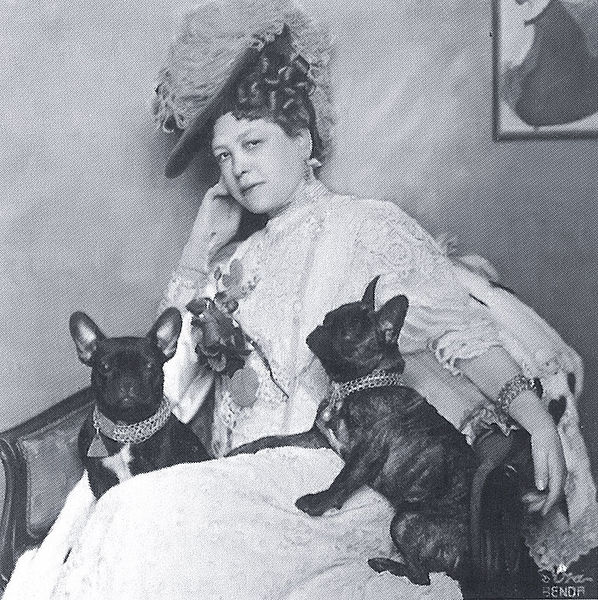
In Paris the breed went from working-class pet to fashion item. Courtesans posed with them on postcards, and writers, artists and fashion people kept them. Toulouse-Lautrec painted Bouboule, the bulldog belonging to Madame Palmyre, owner of the café La Souris, in 1897. Later the novelist Colette was photographed with four of them.[1] The fashion spread across Europe, as this photo from Vienna shows.
How American owners gave the Frenchie its bat ears
Americans started a serious breeding program around 1885, and society women first showed French Bulldogs at the Westminster Kennel Club show in 1896. The next year the judge, George Raper, placed only dogs with folded "rose" ears like an English Bulldog's. The owners objected. They founded the French Bull Dog Club of America in 1897 and wrote a standard that required the upright bat ear.[1] That ear is still a disqualification point: under the current AKC standard, any ear other than a bat ear disqualifies the dog.[2]
The AKC recognized the breed soon afterwards, and by 1906 it was the fifth most popular breed in the country. Good dogs sold for as much as $3,000, and the Rockefellers and J. P. Morgans owned them.[1] In April 1912 the Philadelphia banker Robert W. Daniel boarded the Titanic with Gamin de Pycombe, a champion Frenchie he had just bought in England for £150. Daniel survived the sinking and the dog did not, and Daniel later included it in his claim to the White Star Line.[3]
In England things went less smoothly. When French imports arrived in 1893, Bulldog breeders were angry, because the dogs did not fit their standard and they did not want the two types mixed. The Kennel Club at first treated them as a kind of Bulldog. A breed club was formed in 1902, and in 1905 The Kennel Club recognized the breed separately, as the Bouledogue Français. The English name French Bulldog followed in 1912.[1]
The breed then fell out of fashion for most of the 20th century. As recently as 2003 it ranked 54th in AKC registrations. Its rise since then has been fast, and it overtook the Labrador Retriever, which had held first place for 31 years.[1]
French Bulldog temperament and personality
The AKC standard describes the French Bulldog temperament as "well behaved, adaptable, and comfortable companions with an affectionate nature and even disposition; generally active, alert, and playful, but not unduly boisterous."[2] Owners would add the clowning, the snoring, and the way a Frenchie follows you from room to room.
- The Frenchie is a companion breed with no working job in its background. Most Frenchies want to be near their people, and many do badly when left alone for long stretches. Signs of separation anxiety include destruction around doors, house soiling and nonstop vocalising.[4] If everyone in the house is out for a full workday, plan for a dog walker or daycare.
- They bark less than most small breeds, which helps in apartments, but they make plenty of other noise: grumbles, yodel-like "talking," snorting and loud snoring.
- With children, Frenchies are sturdy for their size and usually tolerant. A toddler can still hurt one, especially by pressing on its back or face, so keep small children and the dog supervised together.
- Most get on with other dogs and cats they are raised with. Some males can be pushy with other males.
Are French Bulldogs smart? Training tips
Yes, but they are independent. A Frenchie works out quickly what earns a treat and is just as quick to ignore a command that earns nothing. Repetitive drilling bores them. What usually works:
- Sessions of five to ten minutes, ending while the dog is still keen.
- Food rewards and play rather than corrections. Harsh handling makes a stubborn dog more stubborn.
- Crate training and a fixed routine for house-training, which can take longer with this breed than with many others.
- Count training treats as part of the daily food ration. Extra weight makes breathing problems worse.
- A harness instead of a collar for walks, so there is no pressure on the throat.
French Bulldog health problems to know before you buy
The Frenchie's flat face, compact spine and narrow hips cause most of its health trouble. A large study by the Royal Veterinary College's VetCompass programme, compared 2,781 French Bulldogs with 21,850 other dogs under UK veterinary care. Frenchies had significantly higher odds of 20 of the 43 most common disorders. Compared with other dogs, they were 42 times more likely to be diagnosed with narrowed nostrils (stenotic nares), 31 times more likely to have brachycephalic obstructive airway syndrome (BOAS), and 11 times more likely to have skin fold dermatitis.[5] They were also less likely than other dogs to have 11 conditions, so the breed's problems cluster around its build.
Breathing problems and heat
French Bulldog breathing problems come from the short skull. Narrow nostrils, a long soft palate and a crowded throat make every breath harder. Do not treat noisy breathing at rest, snoring that wakes the household, gagging, or tiring after a few minutes of play as normal "Frenchie noises." They are clinical signs, and surgery to widen the nostrils and shorten the palate can help a lot. When buying a puppy, ask whether the parents were graded under the University of Cambridge and Kennel Club Respiratory Function Grading Scheme. It is the best tool available for choosing better-breathing lines.
Dogs cool themselves by panting, and a blocked airway makes panting less effective. In a VetCompass study of more than 900,000 dogs, French Bulldogs were among the breeds most at risk of heatstroke. Their annual rate of heat-related illness was more than four times the rate for dogs overall.[6] In practice that means:
- Walk early and late in summer, and skip the walk on hot, humid days.
- Never leave the dog in a car, even for a few minutes.
- Keep a lean body weight. Fat around the throat narrows the airway further.
- Learn the warning signs (frantic panting, a dark red or bluish tongue, stumbling) and get to a vet immediately. Cool the dog with water on the way.
- Check airline rules before you travel. Many carriers do not fly snub-nosed breeds in the hold.
Spine, birth, skin and ears
- Malformed "butterfly" vertebrae (hemivertebrae) are common in the breed, and Frenchies are prone to intervertebral disc disease. Sudden reluctance to jump, a hunched back or wobbly hind legs needs a vet visit the same day.[1]
- Big heads and narrow hips mean most litters, over 80% in published figures, are delivered by caesarean section, and dystocia (difficult labour) is far more common than in other breeds.[1][5] This is one reason puppies are expensive.
- In an earlier VetCompass study of 2,228 Frenchies, ear infections were the single most common diagnosis (14%), and skin disorders were the most common group of problems overall.[7] Wipe out the facial folds and check the ears every week.
- The prominent eyes are easily scratched, and conjunctivitis is common.[7]
Can French Bulldogs swim?
Mostly, no. A heavy front end, a short neck and a face that has to stay tilted up to breathe make a Frenchie sink nose-first rather than paddle. A few can manage a short, frantic doggy-paddle, but they tire within seconds. If you have a pool, fence it or install a ramp, and put a fitted dog life jacket with a grab handle on your Frenchie around boats, lakes and the beach. Never leave the dog unsupervised near water.
Do French Bulldogs shed?
Yes, though not much. The coat is short, smooth and fine, and sheds lightly all year with a heavier shed once or twice a year. A rubber curry brush once a week and an occasional bath cover it. The thin coat gives little protection from cold, so a Frenchie in a cold climate needs a coat for winter walks.
French Bulldog colors and the breed standard
The AKC standard allows white, cream and fawn (from light fawn to red fawn), alone or combined, with brindle, piebald, black mask, black shading or white markings. It names as disqualifications solid black, black and tan, black and white, white with black, blue, blue fawn, liver and merle.[2] The FCI standard used across Europe is shorter: fawn, brindled or not, with or without white spotting. It disqualifies black, black and tan, and "all dilutions of black." All-white dogs are allowed but not bred for, because of the risk of deafness.[8]
This matters because blue, lilac, "isabella" and merle Frenchies are widely sold as rare colors at higher prices. None of them appear in the breed's early history; the dilution and merle genes behind them came in through crossing with other breeds. Dilute coats are linked to colour dilution alopecia, a form of hair loss and flaky skin. Breeding two merles together can produce puppies that are deaf or have eye defects. The standard also caps weight at 28 pounds and disqualifies blue or green eyes.[2]
Fun facts about French Bulldogs
- The French name bouledogue is a French spelling of the English "bulldog," and it also happens to read as boule (ball) plus dogue (mastiff).[1]
- The hind legs are longer than the front legs, which gives the breed its "roach back," with the loin higher than the shoulders.[2] It also explains the "frog" pose, with both hind legs stretched out flat behind.
- The tail is naturally short, either straight or screwed. It is not docked.[2]
- The current FCI standard (2023) lists "respiratory distress" as a disqualifying fault, so a dog that cannot breathe properly cannot win in the show ring.[8]
- Many French Bulldog litters are conceived by artificial insemination, because the breed's build makes natural mating difficult.
References:
- French Bulldog, Wikipedia (history drawn largely from Coile, D. Caroline (2005), French Bulldogs, Barron's, and Leighton, R., The New Book of the Dog, 1907).
- Official Standard of the French Bulldog, American Kennel Club (effective June 5, 2018).
- Robert Williams Daniel, Wikipedia (citing Don Lynch, Titanic: An Illustrated History, 1992).
- Schwartz, Stefanie (June 2003). "Separation anxiety syndrome in dogs and cats". Journal of the American Veterinary Medical Association 222 (11): 1526-1532.
- O'Neill, D. G. et al. (2021). "French Bulldogs differ to other dogs in the UK in propensity for many common disorders: a VetCompass study". Canine Medicine and Genetics.
- Hall, E. J., Carter, A. J. & O'Neill, D. G. (2020). "Incidence and risk factors for heat-related illness (heatstroke) in UK dogs under primary veterinary care in 2016". Scientific Reports.
- O'Neill, D. G. et al. (2018). "Demography and disorders of the French Bulldog population under primary veterinary care in the UK in 2013". Canine Genetics and Epidemiology.
- FCI Standard No. 101: French Bulldog, Fédération Cynologique Internationale.
Video about French Bulldog breed

Questions and answers about French Bulldog
The average life expectancy of a French Bulldog is between 10 - 12 years.
If your French Bulldog is pregnant, it is safe to assume that litter can have anywhere from 3 to 5 puppies.
If you purchase French Bulldog from a breeder it can be much more expensive than a shelter. A purebred French Bulldog costs between US$ 2000 and US$ 4000 from a reputable breeder, but there are several advantages to doing so. First, a breeder will usually allow you to meet the parents to get a good idea about what the puppy will look like and behave. You will also see if the parents have any health problems. Breeders will also supply you with paperwork that documents your pet’s lineage.
Yes. The French Bulldog is the most popular dog breed in the USA. It ranked 1st of 202 breeds in 2025 in the American Kennel Club (AKC) registration statistics. Rose from 11th in 2013 to 1st in 2025.
No, French Bulldog are not considered hypoallergenic dogs. If you are thinking about getting a French Bulldog and have allergies, it's important to spend time with the breed to see how you react before bringing one into your home. This can help you make an informed decision about whether a French Bulldog is the right pet for you, and if so, what steps you may need to take to manage any allergy symptoms.
- https://www.akc.org
- FCI standard
- Kennel club standard
- Wikipedia https://en.wikipedia.org/wiki/French_Bulldog
Next and previous breeds by Popularity

Labrador Retriever
Popularity: №2