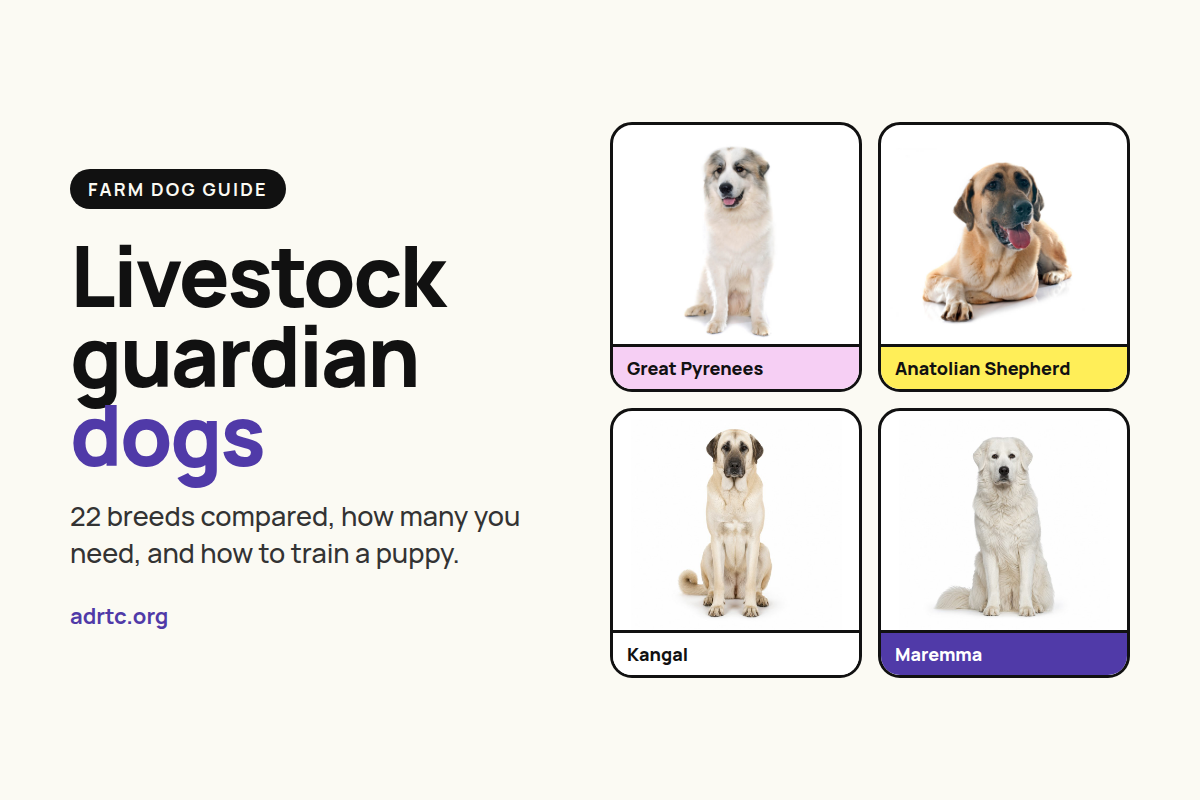
Livestock guardian dogs (LGDs), sometimes called guardian livestock dogs, are large, independent dogs bred to live with sheep, goats and other stock and keep predators away from them, day and night. Coyotes are the leading predator of sheep and goats in the US, and guardian dogs are especially effective against them, according to Texas A&M AgriLife Extension. In 2019, coyotes killed more than 91,000 lambs and 31,000 ewes across the country (USDA figures cited by SDSU Extension).
The breed data below comes from our breed pages. The advice on how many dogs to run and how to bond and train a puppy comes from Texas A&M, South Dakota State and UC Cooperative Extension.
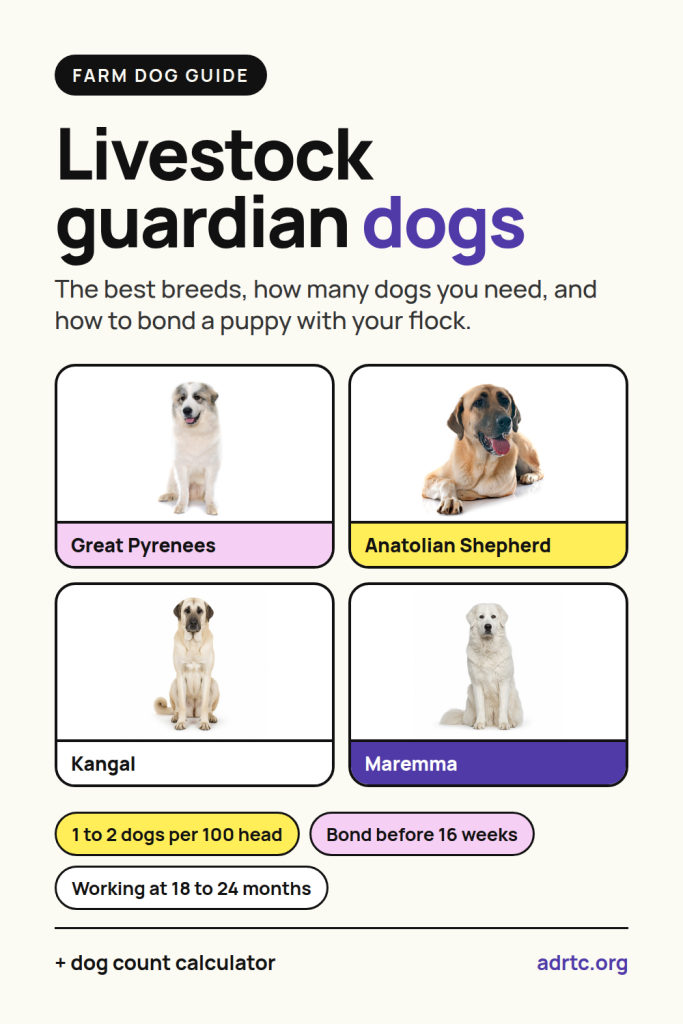
Key takeaways
- Great Pyrenees, Anatolian Shepherd, Maremma and Akbash are the most common guardian breeds in Texas (Texas A&M).
- Plan on 1 to 2 dogs per 100 sheep or goats, or per 50 where wolves, bears or mountain lions hunt.
- Bond puppies with livestock young: research suggests the bond may not form if it starts after 16 weeks.
- A puppy takes 18 to 24 months to become an effective guardian.
In this guide
- What is a livestock guardian dog?
- Types of livestock guardian dogs
- Livestock guardian dog breeds compared
- Best livestock guardian dog breeds
- Largest livestock guardian dog breeds
- How many guardian dogs you need
- Livestock guardian dogs for goats
- Livestock guardian dogs for chickens
- How to train a livestock guardian dog
- What a guardian dog costs
- FAQ
What is a livestock guardian dog?
A livestock guardian dog lives with the flock full time and treats the animals as part of its group. Texas A&M describes three ways a guardian dog stops predators: it marks and holds a territory that other canines avoid, it drives intruders off with barking and posturing, and, if that fails, it confronts them.
Livestock guardian dog
- Lives with the flock day and night
- Keeps predators away from the animals
- Works on its own judgment, with little command work
- Examples: Great Pyrenees, Anatolian Shepherd, Maremma Sheepdog
Herding dog
- Works alongside a handler
- Moves and gathers the flock on command
- Usually goes home with the handler
- Examples: Border Collie, Australian Shepherd
Texas A&M notes that breeds that hunt or herd rarely become effective guardians.
Guardian breeds are also different from home guard dogs. Our list of guard dog breeds covers dogs bred to protect a house and family.
Types of livestock guardian dogs
Guardian dogs differ in how they work. Texas A&M observes that some dogs stay with the livestock all the time while others patrol the perimeter, and some chase predators while others stay with the flock and bark. It calls matching a dog’s behavior to your needs essential.
By origin, most guardian breeds come from the old sheep-herding regions of Europe and Asia:
| Region | Guardian breeds |
|---|---|
| Turkey | Anatolian Shepherd, Kangal, Akbash |
| Pyrenees and Iberia | Great Pyrenees, Pyrenean Mastiff, Spanish Mastiff, Rafeiro do Alentejo |
| Italy | Maremma Sheepdog |
| Central Europe and the Balkans | Komondor, Kuvasz, Slovensky Cuvac, Polish Tatra Sheepdog, Sarplaninac, Tornjak, Karst Shepherd, Bulgarian Shepherd, Mioritic Shepherd |
| Caucasus, Russia and Central Asia | Caucasian Ovcharka, South Russian Ovcharka, Central Asian Ovtcharka |
| Tibet and North Africa | Tibetan Mastiff, Aidi |
Crossbreds are common on working ranches too. SDSU Extension reports that the most used dogs in northwestern South Dakota, often crossbreds, are Akbash, Anatolian, Great Pyrenees and Kangal.
Livestock guardian dog breeds compared
Our ratings for all 22 guardian breeds, from 1 (low) to 5 (high). A low score with strangers is normal for a guardian; it is still worth weighing if you have visitors, hikers or close neighbors.
Filter the table
| Breed | Origin | Size | Male weight | Life span | Strangers | Kids | Training | Barking | AKC rank 2025 |
|---|---|---|---|---|---|---|---|---|---|
| Great Pyrenees | France Spain | Giant | 100+ lb | 10 to 12 years | 3/5 | 4/5 | 1/5 | 5/5 | 66 of 202 |
| Anatolian Shepherd | Turkey | Giant | 100 to 150 lb | 10 to 13 years | 1/5 | 2/5 | 4/5 | 2/5 | 88 of 202 |
| Kangal | Turkey | Giant | 110 to 145 lb | 12 to 15 years | 1/5 | 3/5 | 2/5 | 3/5 | Not ranked |
| Akbash | Turkey | Large, Giant | 90 to 140 lb | 10 to 12 years | 2/5 | 4/5 | 3/5 | 3/5 | Not ranked |
| Maremma Sheepdog | Italy | Large, Giant | 88 to 115 lb | 11 to 13 years | 1/5 | 4/5 | 1/5 | 2/5 | Not ranked |
| Komondor | Hungary | Large, Giant | 110 to 132 lb | 10 to 12 years | 1/5 | 3/5 | 4/5 | 5/5 | 185 of 202 |
| Aidi | Morocco | Medium | 48 to 57 lb | 10 to 12 years | 2/5 | 3/5 | 3/5 | 4/5 | Not ranked |
| Bulgarian Shepherd | Bulgaria | Large, Giant | 99 to 125 lb | 12 to 14 years | n/a | n/a | n/a | n/a | Not ranked |
| Caucasian Ovcharka | Armenia Azerbaijan Georgia | Giant | 110 to 220 lb | 10 to 12 years | 1/5 | 2/5 | 2/5 | 4/5 | Not ranked |
| Central Asian Ovtcharka | Russia | Large, Giant | 121 to 176 lb | 12 to 14 years | 1/5 | 3/5 | 2/5 | 4/5 | Not ranked |
| Karst Shepherd | Slovenia | Medium, Large | 66 to 93 lb | 11 to 12 years | 1/5 | 3/5 | 3/5 | 3/5 | Not ranked |
| Kuvasz | Hungary | Giant | 100 to 115 lb | 10 to 12 years | 1/5 | 1/5 | 2/5 | 3/5 | 179 of 202 |
| Mioritic Shepherd | Romania | Large | n/a | 12 to 14 years | 2/5 | 4/5 | 3/5 | 4/5 | Not ranked |
| Polish Tatra Sheepdog | Poland | Large | 77 to 132 lb | 10 to 12 years | 2/5 | 4/5 | 2/5 | 4/5 | Not ranked |
| Pyrenean Mastiff | Spain | Giant | 176 to 220 lb | 10 to 12 years | 1/5 | 4/5 | 3/5 | 3/5 | Not ranked |
| Rafeiro do Alentejo | Portugal | Giant | 110 to 132 lb | 10 to 12 years | 1/5 | 3/5 | 2/5 | 3/5 | Not ranked |
| Sarplaninac | Macedonia Kosovo | Large | 77 to 99 lb | 11 to 13 years | 1/5 | 3/5 | 1/5 | 3/5 | Not ranked |
| Slovensky Cuvac | Slovakia | Large | 79 to 97 lb | 11 to 13 years | 1/5 | 3/5 | 2/5 | 4/5 | Not ranked |
| South Russian Ovcharka | Russia Ukraine | Large | 88 to 132 lb | 9 to 11 years | 1/5 | 2/5 | 2/5 | 3/5 | Not ranked |
| Spanish Mastiff | Spain | Giant | 198 to 220 lb | 10 to 12 years | 2/5 | 4/5 | 2/5 | 1/5 | Not ranked |
| Tibetan Mastiff | China | Giant | 90 to 150 lb | 10 to 14 years | 2/5 | 5/5 | 1/5 | 2/5 | 142 of 202 |
| Tornjak | Croatia Bosnia and Herzegovina | Large | 77 to 110 lb | 10 to 12 years | 2/5 | 4/5 | 3/5 | 3/5 | Not ranked |
Best livestock guardian dog breeds
There is no single best livestock guardian dog. Texas A&M recommends the Great Pyrenees, Anatolian Shepherd, Maremma and Akbash, the most common guardians in Texas, and stresses that individual dogs within each breed vary widely. SDSU Extension adds the Komondor to the most used breeds in the US, plus the Kangal and Karakachan where larger predators are a problem. These are the best livestock guardian dogs to start with.
Great Pyrenees livestock guardian dogs

The Great Pyrenees is the most common guardian dog in survey data, Texas A&M reports, thanks to its reputation as a good guardian and its generally less aggressive nature toward people and livestock. That makes Great Pyrenees livestock guardian dogs a good fit for small flocks in more populated areas.
Males weigh 100 lb or more. We rate the breed 4/5 with kids but 5/5 for barking and 1/5 for ease of training. Its long coat can be a real problem in hot climates such as Texas, so plan on grooming.
Anatolian livestock guardian dogs

The Anatolian Shepherd comes from Turkey. It is among the most common guardian breeds in Texas (Texas A&M) and the most used across the US (SDSU). Anatolian livestock guardian dogs are big: males weigh 100 to 150 lb.
It rates 1/5 with strangers, so it is wary of people it does not know, but 4/5 for ease of training, unusually high for a guardian. It barks less than most (2/5). It ranked 88th of 202 breeds with the AKC in 2025.
Kangal livestock guardian dogs
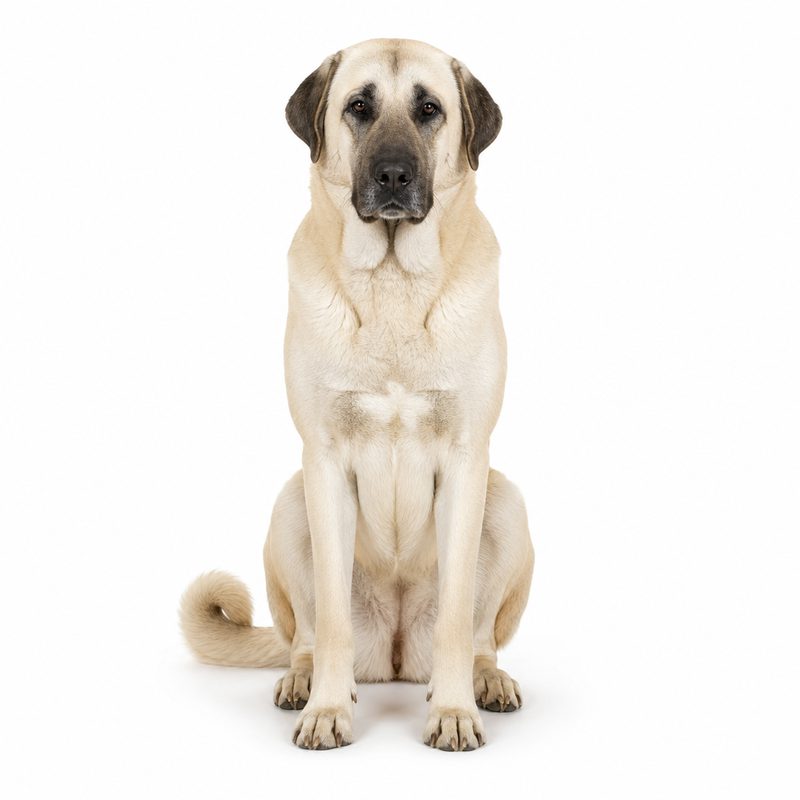
The Kangal is another Turkish breed, with males of 110 to 145 lb and one of the longer life spans here, 12 to 15 years. SDSU Extension says producers facing larger predators have turned increasingly to Kangal livestock guardian dogs.
Research across the northwestern US found little behavioral difference between Kangals, Karakachans and traditional white guardian dogs in how they responded to wolves (Kinka and Young, 2018, cited by SDSU).
Akbash livestock guardian dogs
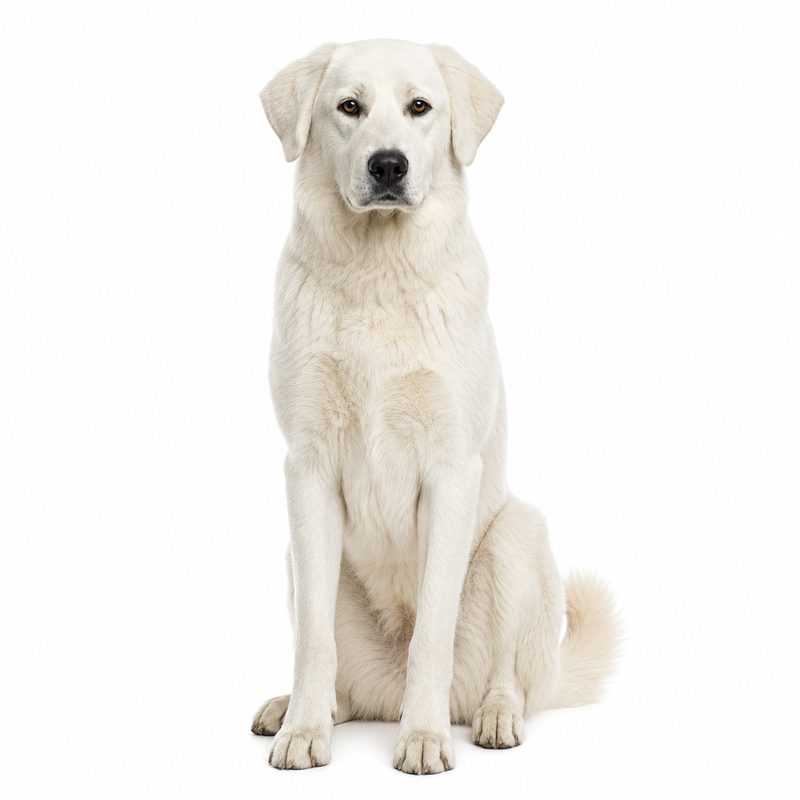
Texas A&M calls the Akbash one of the most aggressive and protective breeds for sheep and goats. That makes Akbash livestock guardian dogs a candidate for large range flocks or heavy predator pressure.
Males weigh 90 to 140 lb. The breed rates 2/5 with strangers and 4/5 with kids on our breed page.
Maremma livestock guardian dogs
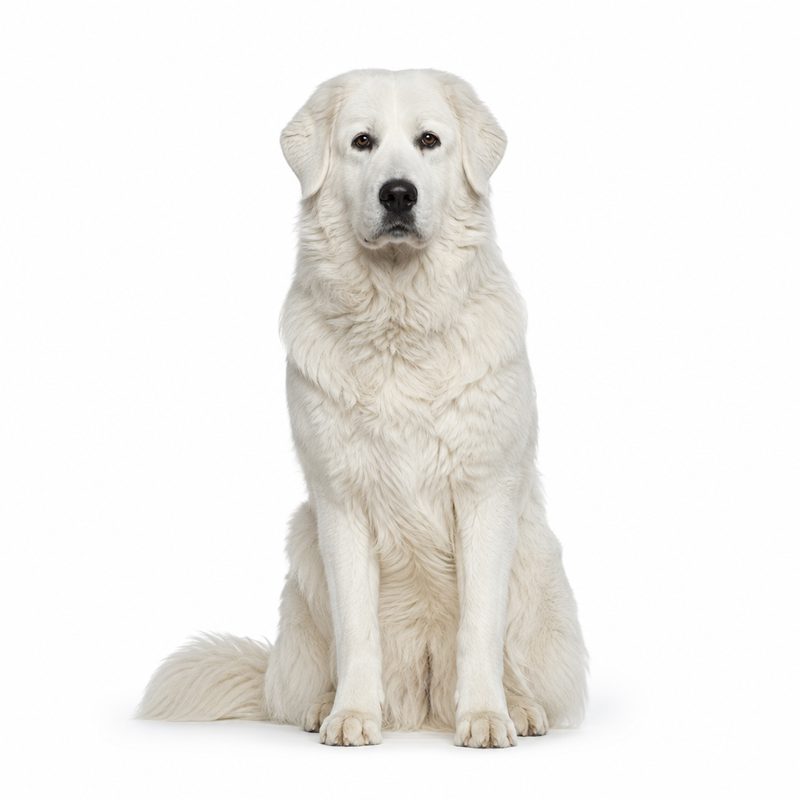
Texas A&M notes that Maremma and Karakachan dogs tend to stay close to their herds. That suits a producer who wants the dog with the animals rather than patrolling far out. The Maremma Sheepdog comes from Italy.
Maremma livestock guardian dogs weigh 88 to 115 lb as males. They rate 1/5 for ease of training and 2/5 for barking.
Komondor

The Komondor from Hungary is one of the most used guardian breeds in the US, according to SDSU. It is known for its corded white coat, and we rate it 2/5 for ease of grooming.
Males weigh 110 to 132 lb. It rates 5/5 for barking and, unusually for a guardian, 4/5 for ease of training.
The Kuvasz and Tibetan Mastiff are guardian breeds too. The Karakachan, mentioned by both Texas A&M and SDSU, does not have a breed page on our site yet.
Largest livestock guardian dog breeds
Most guardian breeds are big: 14 of the 22 are giant breeds on our pages. The biggest by male weight on our breed pages are the mastiff types from Spain and the Caucasus, which can top 200 lb.
Size alone does not make a good guardian. Texas A&M stresses that individual dogs vary widely within every breed, so watch how each dog behaves with your stock.
How many livestock guardian dogs do you need?
Texas A&M generally recommends one to two dogs per 100 ewes or nannies. With large predators such as wolves, bears or mountain lions, or with many predators, that rises to one to two dogs per 50. Flocks of 1,000 or more usually have no more than eight. Producers running several species on rotational grazing may need one dog per species.
Two dogs are generally better than one, except for small flocks near the house, because the stock stays protected if one dog is lost. SDSU producers go further and recommend never running a single guardian with a flock.
Guardian dog calculator
Based on Texas A&M AgriLife guidance and SDSU producer advice. Terrain, fencing and dog behavior change the real number.
Livestock guardian dogs for goats
Sheep and goats are the animals the extension research above focuses on, so the advice applies directly. The same rule of one to two dogs per 100 nannies applies. Texas A&M bonds puppies with several kinds of stock, such as hair and wool sheep and meat and Angora goats, so a dog raised with one does not treat the other as a stranger.
Watch young dogs around kids (baby goats). SDSU warns that playful puppies need close attention around young livestock, and that protective mothers can scare a young dog away from the herd.
Livestock guardian dogs for chickens
A livestock guardian dog for chickens is a harder match. The extension guides we used focus on sheep, goats and cattle and give no poultry-specific advice. Texas A&M does note that young dogs between 6 and 18 months may chase animals in larger pastures.
If you want a dog with poultry, the general guidance still applies: bond the puppy with the birds it will guard, supervise it closely through its first two years, and correct chasing at once. You can also look for an adult dog that a breeder has already proven with small livestock.
How to train a livestock guardian dog
Training livestock guardian dogs is mostly about bonding and supervision. The puppy must grow up with the animals it will guard. Texas A&M advises against bringing the puppy into your home to socialize it.
- 4 to 8 weeks Start bonding with livestock, ideally while the pups are still nursing (Texas A&M). UC Cooperative Extension says to begin by 8 to 10 weeks.
- 8 to 12 weeks Keep one or two pups in a small pen (about 3,600 sq ft) with four to six calm, dog-friendly animals, plus a pup-only feeding area.
- By 16 weeks Research suggests a bond may not form if the introduction starts after 16 weeks.
- 12 weeks to 6 months Move pups and their bonded stock to a training pen of about 1 acre and watch them closely.
- 6 to 10 months Move to small training pastures of roughly 25 to 50 acres.
- 6 to 18 months Expect chasing. Correct it immediately; a dangle stick on the collar slows a chaser.
- 18 to 24 months Most dogs become effective guardians. SDSU notes dogs under 2 may not be as effective as adults.
What to teach a guardian puppy
- "Come", practiced at feeding time with the livestock, and "stay" each time you leave the pen.
- A firm "no" for chewing or biting livestock, which is common during bonding.
- Walking on a leash and accepting a tether, starting with a minute or two and building up week by week.
- Fence respect. Texas A&M calls it the most important lesson.
Fence respect matters because roaming kills guardian dogs. In a study cited by Texas A&M, only 52% of guardian dogs lived to age 6, and 57% of deaths happened after the dog left the property (Lorenz et al., 1986).
Socialize the dog with you as well. Texas A&M found that 15 to 20 minutes of handling, three to four times a week during bonding, produces adult dogs you can catch and care for. Praise the dog when you find it with the livestock, and return it without reward when you find it elsewhere.
Tip: UC Cooperative Extension suggests watching the pup from a distance. A good guardian pup approaches livestock slowly and calmly, avoids eye contact and may sleep next to them. Stalking or chasing needs a gruff "no" at once.
What a livestock guardian dog costs
Texas A&M puts the initial cost of a new guardian dog at $1,800 or more, and about $2,000 for the whole first year, then about $1,000 in the second year and $900 a year after that. By age 4, a dog only needs to save five lambs a year to cover its cost, based on an 80 lb market lamb at $175.
| Year | Approximate cost |
|---|---|
| Year 1 (purchase and care) | $2,000 |
| Year 2 | $1,000 |
| Each year after | $900 |
Some breeders sell dogs already bonded or trained. They cost more but can start work right away, which Texas A&M says can make sense if you are facing heavy losses now. Ask about guarantees, since a bought dog can still run off or fail to bond with your stock. UC Cooperative Extension advises buying pups from working parents and seeing the parents at work.
FAQ about livestock guardian dogs
What is the best livestock guardian dog?
There is no single best breed. The Great Pyrenees is the most common and generally less aggressive toward people, which suits small farms. The Akbash and Kangal suit heavier predator pressure, and the Maremma tends to stay close to the flock. Individual dogs within each breed vary widely.
At what age does a livestock guardian dog start working?
Texas A&M says puppies take 18 to 24 months to become effective guardians. Until then, supervise them closely.
Can a livestock guardian dog be a family pet?
It is a working dog first. Texas A&M advises keeping the puppy with livestock rather than in the house during bonding. Many guardian breeds also rate low for ease of training and high for barking on our breed pages.
Is a male or female livestock guardian dog better?
Either can work. Texas A&M reports no difference in guarding ability between males and females, or between neutered and intact dogs. Neutering males often reduces roaming.
Can a herding dog guard livestock?
Rarely. Texas A&M notes that breeds that hunt or herd tend to show behaviors that work against guarding sheep and goats.
Will a guardian dog bother wildlife?
Sometimes. Texas A&M documents guardian dogs chasing deer and disturbing ground-nesting birds, and recommends checking local wildlife laws and correcting the behavior early.
Read more about each breed on our breed pages, or see our list of giant dog breeds.
Leave a Reply